Early this morning, I let the dogs out to run in a fenced area behind the agility field. Behind this section of the yard is two acres fenced. Melissa took of running. Her intent was clear, she was chasing something. Through the leaves on the far side of the fence I saw a buck. Melissa was in hot pursuit. My heart skipped a beat as I realized I had not checked the fence line after we had some heavy rain and wind. I was stumbling over fallen limbs to get to Melissa. Was the fence down? Would she run into it? Obviously the perimeter fence was down to permit the deer to enter the back two acres.
Without thinking I called out 'Lissa'. She had been trained to come when she hears her name, but not with this level of distraction. I didn't want her crashing into the fence, nor did I want her to get into the back area with the buck if the fence was down where Melissa was running. Upon hearing her name, 13 month old Melissa turned instantly ....and came running back to me!! Melissa got lots of praise and all the treats in my pocket! The many months of practicing Leslie Nelson's Really Reliable Recall with Melissa worked!
I will not slack off training after this one perfectly wonderful response. I will maintain name response by practicing and rewarding generously, I will continue to make deposits into the 'come when called' bank account. There may be another time in Melissa's future that I need to call her away from something very enticing, I want the same response as I had early this morning. Good girl Melissa, you did well!!
Thursday, September 30, 2010


Wednesday, September 22, 2010
Tug of War
 I really like to play tug with my dogs. It is a wonderful game to burn off energy. It is a way to play with our dogs indoors and out. But, as with all games, it comes with some rules. You may have heard that tug of war can make our dogs be out of control, show some aggressive behaviors and horrors, be dominant! Not so, if played by the rules, and honestly dogs are not trying to take over our world. If we did not have rules to follow when driving our cars we would have chaos on the road. We follow rules, we stop at red lights, go on green, stop at stop signs, drive on the correct side of the road. Our dogs learn to follow rules when the come to live with us, the learn to sit, wait, and be polite when greeting visitors etc. They must also follow the rules for tug of war.
 1) Melissa must wait for an invitation from me to engage with the toy. Never is she allowed to just grab the toy from my hand. This is a self control skill. In the beginning I allowed her to stand before releasing her to the toy, but once sit was on cue, she was asked to sit.
2) She is allowed to move forward to get the toy when she hears 'get it'. As I say this, I also begin moving the toy around. The movement makes it more exciting and Melissa leaps out of a sit to get it.


3) Since I have multiple dogs, I release them to play with their name first then 'get it'. One dog at a time gets to play tug with me. Here Lucy patiently waits patiently for her turn to play.
4) Any time teeth are felt on my skin, the game is over. I let go of the toy and walk away. Melissa has a soft mouth, but even the tiniest feel of teeth on my hand, was enough for me to release the toy and move away. Game over. It took Melissa two repetitions to learn that her teeth were not to touch my skin. Lab Lucy took more reps., she tugs harder and for a longer period of time. I used a lower value toy to begin with, and followed the protocol of stopping the game as just described. Once she understood the rule of no teeth on skin, I increased the value of the toy.
5) Ending the game of tug. Dogs must learn a 'give or drop it cue'. Tug takes two to play. If I stop tugging and hold the toy close to my body, it is not as much fun. I taught this to Melissa by ceasing to tug as I held the toy close to my body. At the same time I offered Melissa a tasty piece of food close to her nose as I said give. Melissa would release the toy and eat the food. I quickly engaged her in another game of tug. Soon Melissa was releasing the toy when she heard the cue to give. I am now beginning to use another game of tug as a reward...she gets to play tug again after she releases the toy. This is an example of how food can be faded out of the picture. Melissa does what I asked, to give the toy to me, and as a reward she gets to play again.
6) Sometimes I let Melissa 'win'. I let go of the toy as I say 'it's yours' and off she goes running with the toy in her mouth. Sometimes I 'win' and end the game and put the toy away. This keeps the game fun for both of us, we both get a chance to have possession at the end of the game. Melissa remains eager to play the game of tug whenever I engage her to do so.

Thursday, September 16, 2010
Walking on Lead
Several owners of new pups have asked me how to teach their pups to walk on lead. Two people in particular are having to pick up their dogs, as they simply stop moving.
If a dog does not want to walk I first look around the environment. Is something out there that is causing the puppy to be afraid, to shut down? It could be something very subtle. A neighbor coming out of their house, a trash can that is at roadside that was not there previously. Perhaps the last time the puppy was out for a walk, an automatic garage door opened and closed and scared the pup. Skateboards, planes over head, cars, cyclists, over head air balloons, all can be a source of something your puppy is unsure of. Did a neighbor's dog give your pup a threatening look, again it could be very subtle. If your pup is not accustomed to reading dog language or the other dog is too assertive, your pup has good reason to be unsure. It could be a combination of some of these things.
I let the pup drag a ribbon or very light line, on a flat buckle collar attached to a front clip harness. The harness prevents any tightening around the collar, many dogs get scared, they feel the pressure and they freeze. Others back off, making it tighter. It can be a scary situation during a critical time in their life.
If you have another dog that the pup will follow, pick up the ribbon or line and follow along. If you have no access to another dog, try having the pup follow a person. The person should be someone the pup knows and is comfortable with. Have them play with the pup and then walk away, chances are the pup will want to follow. You will pick up the ribbon or light lead and follow along.
This is your pup's first lesson in lead training. On a separate topic: put on your to do list: find another pup or appropriate adult for your puppy to play with, it is a critical part of his socialization.
Let the pup lead you the first few times. No need to put pressure on his collar/harness. I train before meals...when Melissa is most hungry. Ok, she is always hungry...I am blessed with yet another Borzoi who is a really good eater. But in the beginning she didn't know what to make of the lead. I let her drag it, when she followed a dog or person, she did feel some pressure on her harness if she got too far in front of me and I couldn't keep up. Life is not totally free of aversives......this is one of those cases that life happens. I never pulled on her collar/harness intentionally. In a separate session I taught her to accept hands touching her all over her body, along with mild pressure on her collar.
When she was comfortable dragging the light line, I began to hold it in my hand.....placing items on the ground that she wanted to investigate toy or a treat, she went in a straight line doing just that....and with me holding the light line. That was training session number two.
When Melissa first arrived I fed the first few meals from my hand, she learned that good things come from me. She focused up at me, we practiced walking on lead, a loose lead, while she followed her food bowl. At this point I began to click and treat when she was close to my left side.
If a puppy won't eat while out on the road, chances are something is bothering him, he has shut down. Practice on the side or back yard of your home, in a quiet parking lot or park where there is minimal distractions to worry him. My favorite place for dogs working thru challenges like this, is a mall parking lot before the stores open. Place toys, plates of food around one parking space before you take your pup out of the car. When you have arranged all the items on the ground, take him out and let him investigate while you hold onto the lead. Verbally praise when he is moving forward. Don't cheer lead when he is stationary. Reward for movement. Keep training sessions short....two to three minutes at most.
Attach a light line or ribbon on your pups collar/harness. Put a fuzzy on a string and let him chase it and catch it. Let him play with it, we want him to get excited about it. Then repeat, but this time you hold the fuzzy off the ground a bit. With you holding his lead, and him following the fuzzy, for a feet feet before you allow him to have it, he has yet another training session for walking on lead.
Buckles on leads....get them as small as you can. Melissa had a buckle made for a toy dog the first week of lead training. No need to weight the pup down with a heavy buckle or heavy lead.
Let them have fun on walks. Formal heeling and walking at your side will come in time. Take things in small increments. Melissa is a year old, I have yet to introduce her to the word 'heel'. Instead I am shaping her to being close to my left side, my left hand at my waist is becoming the cue. She looks forward to moving close to my side, it means lots of clicks and treats are coming her way.
Take all training in tiny increments, the final goal will come. As friend and instructor Patty Ruzzo used to say 'enjoy the journey'. And so it should be with all we do with our dogs, from puppy hood to adult hood. Happy training!
If a dog does not want to walk I first look around the environment. Is something out there that is causing the puppy to be afraid, to shut down? It could be something very subtle. A neighbor coming out of their house, a trash can that is at roadside that was not there previously. Perhaps the last time the puppy was out for a walk, an automatic garage door opened and closed and scared the pup. Skateboards, planes over head, cars, cyclists, over head air balloons, all can be a source of something your puppy is unsure of. Did a neighbor's dog give your pup a threatening look, again it could be very subtle. If your pup is not accustomed to reading dog language or the other dog is too assertive, your pup has good reason to be unsure. It could be a combination of some of these things.
I let the pup drag a ribbon or very light line, on a flat buckle collar attached to a front clip harness. The harness prevents any tightening around the collar, many dogs get scared, they feel the pressure and they freeze. Others back off, making it tighter. It can be a scary situation during a critical time in their life.
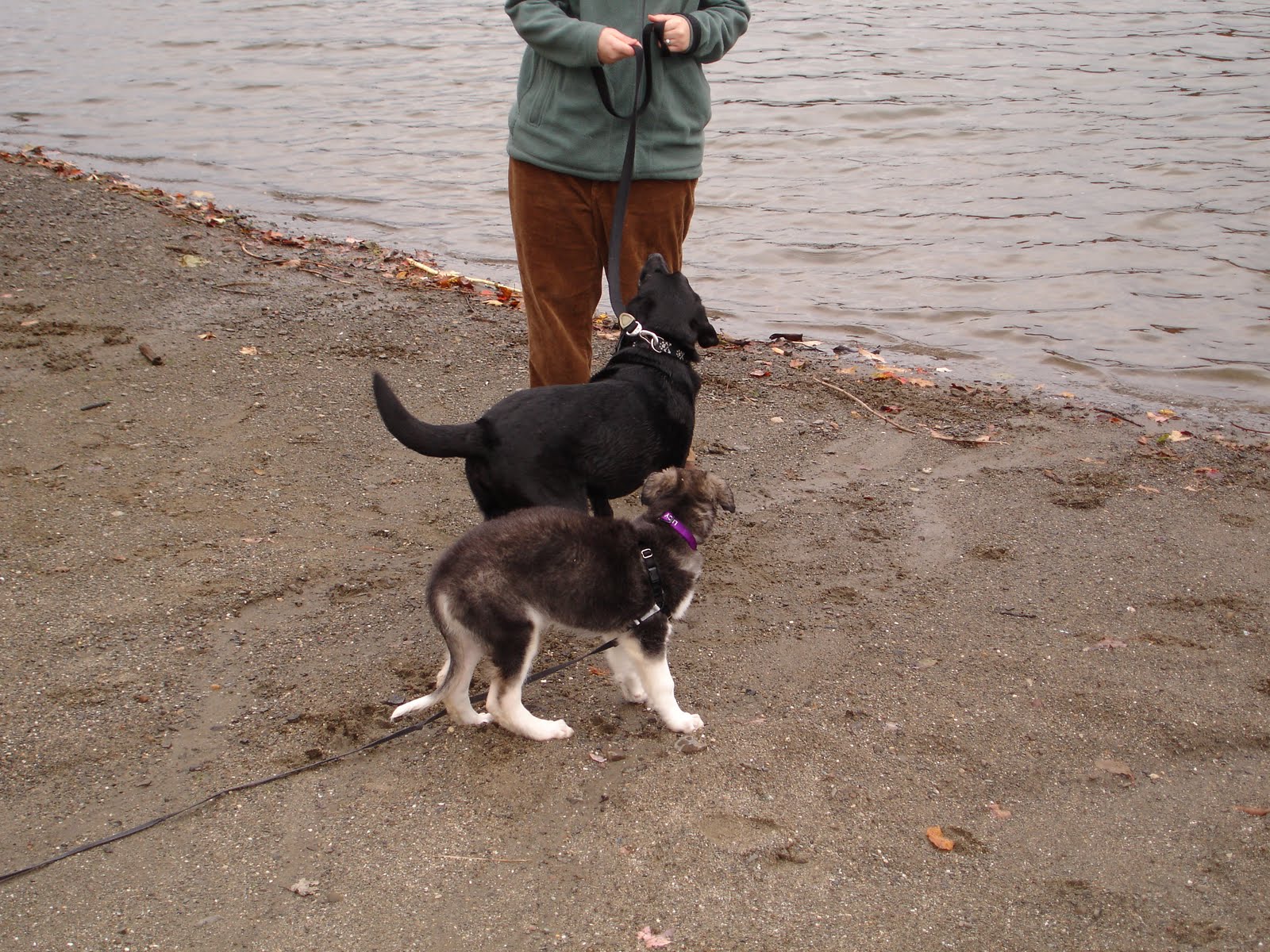
If you have another dog that the pup will follow, pick up the ribbon or line and follow along. If you have no access to another dog, try having the pup follow a person. The person should be someone the pup knows and is comfortable with. Have them play with the pup and then walk away, chances are the pup will want to follow. You will pick up the ribbon or light lead and follow along.
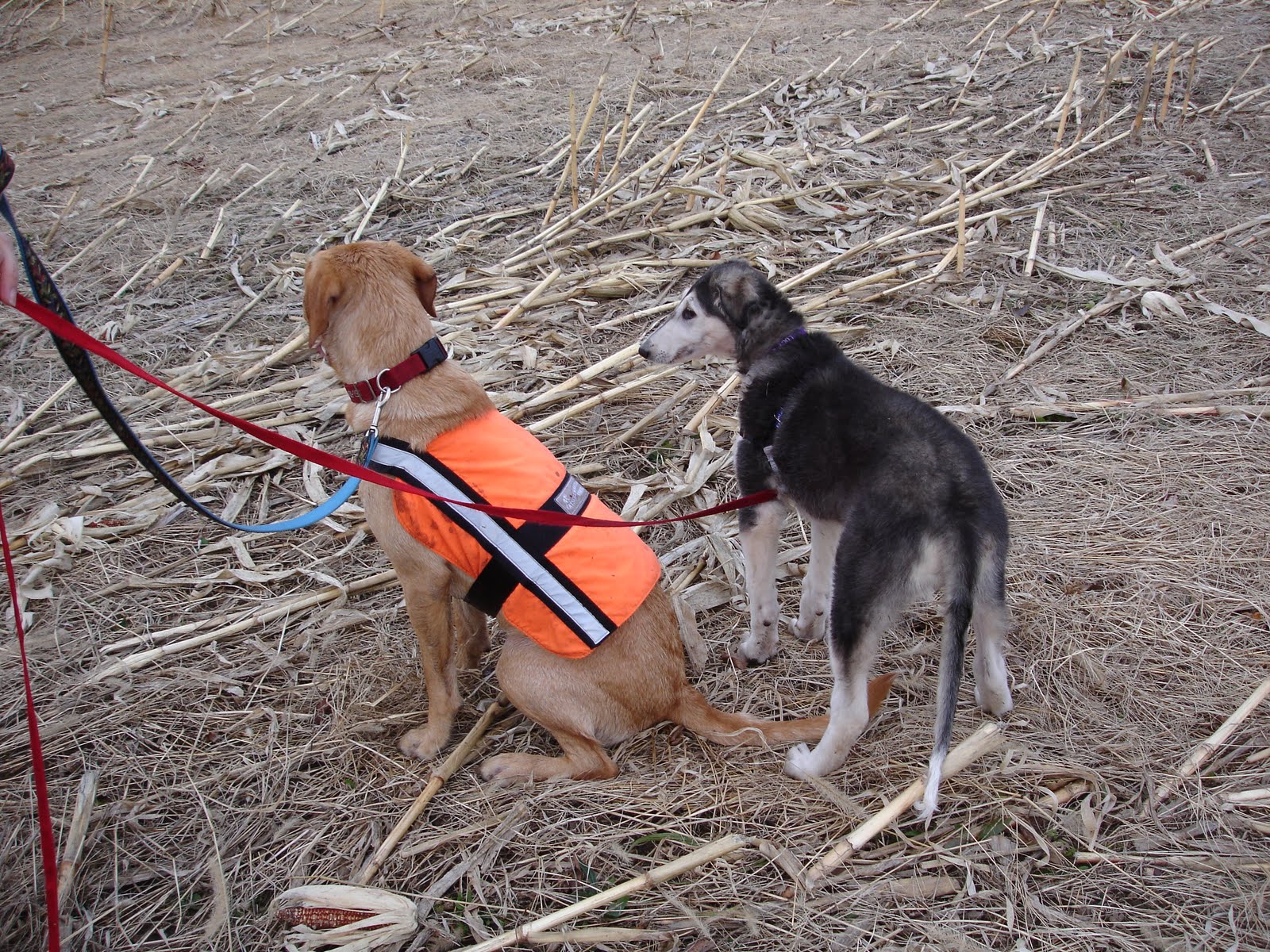
This is your pup's first lesson in lead training. On a separate topic: put on your to do list: find another pup or appropriate adult for your puppy to play with, it is a critical part of his socialization.
Let the pup lead you the first few times. No need to put pressure on his collar/harness. I train before meals...when Melissa is most hungry. Ok, she is always hungry...I am blessed with yet another Borzoi who is a really good eater. But in the beginning she didn't know what to make of the lead. I let her drag it, when she followed a dog or person, she did feel some pressure on her harness if she got too far in front of me and I couldn't keep up. Life is not totally free of aversives......this is one of those cases that life happens. I never pulled on her collar/harness intentionally. In a separate session I taught her to accept hands touching her all over her body, along with mild pressure on her collar.
When she was comfortable dragging the light line, I began to hold it in my hand.....placing items on the ground that she wanted to investigate toy or a treat, she went in a straight line doing just that....and with me holding the light line. That was training session number two.
When Melissa first arrived I fed the first few meals from my hand, she learned that good things come from me. She focused up at me, we practiced walking on lead, a loose lead, while she followed her food bowl. At this point I began to click and treat when she was close to my left side.
If a puppy won't eat while out on the road, chances are something is bothering him, he has shut down. Practice on the side or back yard of your home, in a quiet parking lot or park where there is minimal distractions to worry him. My favorite place for dogs working thru challenges like this, is a mall parking lot before the stores open. Place toys, plates of food around one parking space before you take your pup out of the car. When you have arranged all the items on the ground, take him out and let him investigate while you hold onto the lead. Verbally praise when he is moving forward. Don't cheer lead when he is stationary. Reward for movement. Keep training sessions short....two to three minutes at most.
Attach a light line or ribbon on your pups collar/harness. Put a fuzzy on a string and let him chase it and catch it. Let him play with it, we want him to get excited about it. Then repeat, but this time you hold the fuzzy off the ground a bit. With you holding his lead, and him following the fuzzy, for a feet feet before you allow him to have it, he has yet another training session for walking on lead.
Buckles on leads....get them as small as you can. Melissa had a buckle made for a toy dog the first week of lead training. No need to weight the pup down with a heavy buckle or heavy lead.
Let them have fun on walks. Formal heeling and walking at your side will come in time. Take things in small increments. Melissa is a year old, I have yet to introduce her to the word 'heel'. Instead I am shaping her to being close to my left side, my left hand at my waist is becoming the cue. She looks forward to moving close to my side, it means lots of clicks and treats are coming her way.
Take all training in tiny increments, the final goal will come. As friend and instructor Patty Ruzzo used to say 'enjoy the journey'. And so it should be with all we do with our dogs, from puppy hood to adult hood. Happy training!
Thursday, September 9, 2010
Grooming Table Update: CLICK!! For Success
A few weeks ago Melissa was hesitant about going onto the 24 inch grooming table. I lowered the table and began to shape any movement towards the table, clicking for appropriate responses. Melissa was quickly running to the table that was a mere few inches off the ground.
 Over the last few weeks I had two additional training sessions with Melissa and the grooming table. I increased the height gradually as I continued to shape Melissa's behavior. The final goal was for her jump onto the table and be totally relaxed.

At each new height, Melissa's enthusiasm for running onto the table grew.
I worked from different angles, to make sure she understood what was expected of her. The leash was held loose at all times.
Melissa is now running to the table and jumping onto it. She is relaxed and eagerly looking to me to do more. What better way to prepare her for future shows: starting with a stress free dog, from the ground up.

Success using the clicker!!
 Over the last few weeks I had two additional training sessions with Melissa and the grooming table. I increased the height gradually as I continued to shape Melissa's behavior. The final goal was for her jump onto the table and be totally relaxed.
At each new height, Melissa's enthusiasm for running onto the table grew.

I worked from different angles, to make sure she understood what was expected of her. The leash was held loose at all times.
Melissa is now running to the table and jumping onto it. She is relaxed and eagerly looking to me to do more. What better way to prepare her for future shows: starting with a stress free dog, from the ground up.

Success using the clicker!!
Monday, August 30, 2010
Dogs Digging
I've written a little bit about Melissa digging in a previous blog: http://hemlockhollowdogtraining.blogspot.com/2010/04/bad-dog-or-bored-dog.html At that time she was digging due to being bored, my schedule was hectic, I didn't give her enough to do.
Dogs dig for various reasons: 1) They are bored as already mentioned. Dirt is fun. Dogs dig, the dirt goes flying. They dig faster, more dirt goes flying. The fresh soil smells good to a dog. They roll in it, they taste it. They are burning off energy. It is our job as their owners to give them lots to do to engage their minds such as interactive toys, games of search, or increase the amount of training sessions per day. Bored dogs are usually under-exercised. Go out in the yard and play fetch, invite a 4 footed friend over so your dog can play, rotate his toys or go on a hike with him.
2) Dogs also dig if they are chasing prey such as moles, chipmunks or bugs...yes they get entertained by bugs. Terriers seem more apt to dig for critters but any dog can.
Dogs will dig in snow to follow moles that for some reason decided to venture out on a warm day.
3) Dogs will dig if they are looking for a means to escape. Their digging is usually around gates and fence lines. If your dog is whining, pacing, panting, and/or digging around these areas he could be stressed about something. He may never have learned to be left alone, he may be suffering from separation distress. Consult a reward-based trainer who uses only humane methods to help you help your dog.

4) Dogs dig to hide items for later use. This is a trait hard wired in some dogs, it is a survival behavior retained from their ancestors. It can be a bone, or it can be a toy, or several toys. Freshly cleaned toys are quickly rolled in the dirt, it seems the more dirt on the toys the better. That is why we have inside toys, and toys that are just for outside.
5) Dogs also dig to keep cool!! Our dogs are inside in AC in the very hot weather. They are in shaded areas when outside.
They are given hammocks to lay on.

A cottage to go into, a kiddy pool to play in, and access to a wooded area ....to dig in.
Dogs that are now gone, began to dig near the roots of a tree that was uprooted during a wind storm over 20 years ago. I am not sure if it was the freshly exposed roots, which were a novel item in the yard, is the reason why they began to dig in this area. Perhaps it was because is was an area that was slightly higher then the rest of the yard and provides a good view of their yard. No matter the reason, many dogs who have lived with us decided that this is a great place to dig and built what I call their 'fort. There are holes behind the fort, in front of it and around it. It is off the side of the dog's area in the yard, it doesn't bother anyone and gives them much pleasure.

Melissa has decided to join in.

She gathers her toys and places them in and around the 'fort'. Sometimes she lies in the hole with the toys. The soil is cooler then the air temp, it must feel good to her. It is her spot to dig, we have never had a dog dig in our lawn or gardens. She is not digging due to boredom, looking for little animals or looking for an escape route. She will dig after a long hike and hours of splashing and swimming. I believe she is digging to keep cool and have a place to watch all that goes on around her. She digs to hide her toys.
And best of all, despite the many dog hammocks in the yard, a hole is a good place to take a nap........my silly muddy nose girl.
Dogs dig for various reasons: 1) They are bored as already mentioned. Dirt is fun. Dogs dig, the dirt goes flying. They dig faster, more dirt goes flying. The fresh soil smells good to a dog. They roll in it, they taste it. They are burning off energy. It is our job as their owners to give them lots to do to engage their minds such as interactive toys, games of search, or increase the amount of training sessions per day. Bored dogs are usually under-exercised. Go out in the yard and play fetch, invite a 4 footed friend over so your dog can play, rotate his toys or go on a hike with him.
2) Dogs also dig if they are chasing prey such as moles, chipmunks or bugs...yes they get entertained by bugs. Terriers seem more apt to dig for critters but any dog can.

Dogs will dig in snow to follow moles that for some reason decided to venture out on a warm day.
3) Dogs will dig if they are looking for a means to escape. Their digging is usually around gates and fence lines. If your dog is whining, pacing, panting, and/or digging around these areas he could be stressed about something. He may never have learned to be left alone, he may be suffering from separation distress. Consult a reward-based trainer who uses only humane methods to help you help your dog.

4) Dogs dig to hide items for later use. This is a trait hard wired in some dogs, it is a survival behavior retained from their ancestors. It can be a bone, or it can be a toy, or several toys. Freshly cleaned toys are quickly rolled in the dirt, it seems the more dirt on the toys the better. That is why we have inside toys, and toys that are just for outside.
5) Dogs also dig to keep cool!! Our dogs are inside in AC in the very hot weather. They are in shaded areas when outside.

They are given hammocks to lay on.

A cottage to go into, a kiddy pool to play in, and access to a wooded area ....to dig in.
Dogs that are now gone, began to dig near the roots of a tree that was uprooted during a wind storm over 20 years ago.
 I am not sure if it was the freshly exposed roots, which were a novel item in the yard, is the reason why they began to dig in this area. Perhaps it was because is was an area that was slightly higher then the rest of the yard and provides a good view of their yard. No matter the reason, many dogs who have lived with us decided that this is a great place to dig and built what I call their 'fort. There are holes behind the fort, in front of it and around it. It is off the side of the dog's area in the yard, it doesn't bother anyone and gives them much pleasure.
Melissa has decided to join in.

She gathers her toys and places them in and around the 'fort'. Sometimes she lies in the hole with the toys. The soil is cooler then the air temp, it must feel good to her. It is her spot to dig, we have never had a dog dig in our lawn or gardens. She is not digging due to boredom, looking for little animals or looking for an escape route. She will dig after a long hike and hours of splashing and swimming. I believe she is digging to keep cool and have a place to watch all that goes on around her. She digs to hide her toys.

And best of all, despite the many dog hammocks in the yard, a hole is a good place to take a nap........my silly muddy nose girl.
Sunday, August 29, 2010
Canine Good Citizen and Pet Therapy
Melissa PASSED!! She passed the Canine Good Citizenship and pet therapy dog test today.
What does this mean? She will be able to visit at local hospitals and nursing homes as a pet therapy dog just like our other dogs do on a weekly basis. She will be able to participate in school and library educational programs. Passing the test demonstrates that we work together as a team and Melissa is able to follow my cues to sit, down, stay, come, being left alone with a stranger, being around medical equipment, people walking with crutches and walkers, along with being able to be in close proximity of distracting items. The distracting items: very close to other dogs, people leaning over her with floppy hats and dangling things from their neck, and several choice pieces of treats on the floor. For a more detailed overview of what the test consists of please see the Therapy Dog International website: http://www.tdi-dog.org/HowToJoin.aspx?Page=Testing+Requirements
The American Kennel Club's CGC program is a certification program that rewards dogs for good manners at home and in the community. For more information: http://www.akc.org/events/cgc/training_testing.cfm
We will need to mail the necessary paperwork, but in a few weeks Melissa will be visiting as a pet therapy dog. For now she is cooling off in her kiddie pool........
What does this mean? She will be able to visit at local hospitals and nursing homes as a pet therapy dog just like our other dogs do on a weekly basis. She will be able to participate in school and library educational programs. Passing the test demonstrates that we work together as a team and Melissa is able to follow my cues to sit, down, stay, come, being left alone with a stranger, being around medical equipment, people walking with crutches and walkers, along with being able to be in close proximity of distracting items. The distracting items: very close to other dogs, people leaning over her with floppy hats and dangling things from their neck, and several choice pieces of treats on the floor. For a more detailed overview of what the test consists of please see the Therapy Dog International website: http://www.tdi-dog.org/HowToJoin.aspx?Page=Testing+Requirements
The American Kennel Club's CGC program is a certification program that rewards dogs for good manners at home and in the community. For more information: http://www.akc.org/events/cgc/training_testing.cfm
We will need to mail the necessary paperwork, but in a few weeks Melissa will be visiting as a pet therapy dog. For now she is cooling off in her kiddie pool........
Thursday, August 26, 2010
Melissa's First Birthday!!!

Melissa is one year old today. She is loosing her puppy curls, she started shedding about 3 weeks ago. This is a normal occurrence. In a month or so her adult coat will begin coming in.
Most of her growth has occurred, but she will put on muscle and weight over the next two years.

She could grow another inch or so.
When we first brought her home 10 months ago she could sit in my lap.


Today she is nearly 70 pounds heavier.
Her body says she is still 'puppy', she runs like a puppy, she stands like a puppy, she does silly things like a puppy. So when is a dog no longer a puppy?
Can she can be expected to act like our older dogs because she is now a year old? No.....today is just another day, a special day since she was born a year ago, but it does not make her suddenly begin an adult and trustworthy in all situations. She is beginning to settle more: taking naps on the couch, taking a dog toy to quietly play with on a dog bed, or just lying at my feet. Of course she gets a bit more freedom after she has had LOTS of exercise and mental stimulation. Setting up good habits while she is young has given her a good foundation for the behaviors we want to see repeated.
Dogs turning a year old are still puppies to me. They are young, they are silly, they are active. They need lots to do. Their socialization and training is still important. They need to continue seeing and doing things outside of their home environment.
So when does puppy hood end and adulthood begin? It depends on the breed, the individual dog, their personality. They mature differently. For now I will continue to enjoy the last of the puppy sillies that Melissa has to offer. We will continue to train and socialize.
We took her hiking this evening with her buddy Buster. Happy Birthday Melissa, it's been a fun year.

Subscribe to:
Posts (Atom)
