Wednesday, October 20, 2010

Halloween Safety Tips


Witches, Ghosts and Goblins can be scary looking to a dog. Consider leaving him home while you take the children out trick or treating. If your dog spends much time outdoors, consider bringing him inside to keep him safe. He may bolt over or through the fence should he get frightened.

Chocolate is toxic to dogs.

Xylitol, the artificial sweetener found in many candies, is poisonous to dogs.

Ingesting any candy, cake, or wrappers can cause intestinal upset.

Open Doors: mean more chance of your dog slipping out. Place him in a crate with a stuffed Kong or bone to work on. If he is not crated trained or has not learned enough manners to remain behind a closed door of a bedroom either tether him or keep him on lead with you in attendance.

Jack-O-Lanterns: While fun to carve and have burning brightly, keep all knives safely out of reach of your dog. If you are using a candle, be cautious; your dog could easily knock it over.

Costumes: You may enjoy dressing up, but your dog may not appreciate it. A festive bandana around his neck, an interactive toy, a quiet place to relax and your pet will be safe for the night.

Have a Safe and Happy Halloween


Thursday, October 14, 2010

Old Dogs, Young Dogs


A year ago, our Borzoi Catera at age 12 was a perfect match for 8 week old puppy Melissa. Catera is gentle, she is very careful where she puts her feet, she has always been very much aware of where she places her body. I could let Catera run with Melissa and knew that Melissa would be safe.

Safe from what? From being stepped on, from being body slammed, or from a harsh reprimand. Reprimands are not bad, but some dogs are not comfortable being around other dogs, especially puppies, and may reprimand a bit too harshly. A young puppy may not heed a well deserved growl if he uses his puppy teeth too hard while playing and the reprimand may escalate. Puppies learn by interacting with appropriate playmates whether they are pups of the same size and age, or a stable adult who has good skills interacting with young pups. I certainly did not want Melissa playing with an adult dog who may have a rough style in playing when she was just a tiny pup. I protected her from being physically hurt. I chose her playmates accordingly.


Dogs have different play styles. Some play rough and body slam. Some like to play chase but have little body contact, some like to roll on the ground and mouth each other for hours. Melissa and Lucy continue to play for hours, gently mouthing each other. Lucy always comes back for more if Melissa stops, a sure sign the dog at the bottom is having fun.


Catera allowed a few nibbles from puppy Melissa but moved away to stop the game when Melissa mouthed too hard. Melissa lost her playmate. The game stopped, she learned to use her mouth softly on Catera.

Fast forward a year. Catera is now a teenager, although still maintaining her weight at 72 pounds she is not as strong as she was when Melissa first arrived. Catera no longer goes on long hikes. Melissa is 85# she is strong and powerful and still developing muscle. Melissa no longer runs with Catera, she could easily knock Catera over, purely by accident. Catera still frolics in the yard, but her pace is slower. She is not as quick to turn, she prefers to walk the property boundaries rather then run long distances. Catera prefers to play with little body contact, where as Melissa enjoys body contact. Some senior dogs continue playing rough and tumble games as if they were youngsters but it is up to us to keep active puppies and strong adolescents from doing any physical damage to our older dogs. Senior dogs still enjoy socializing with pups, we just need to monitor that the pup does not overdo things.


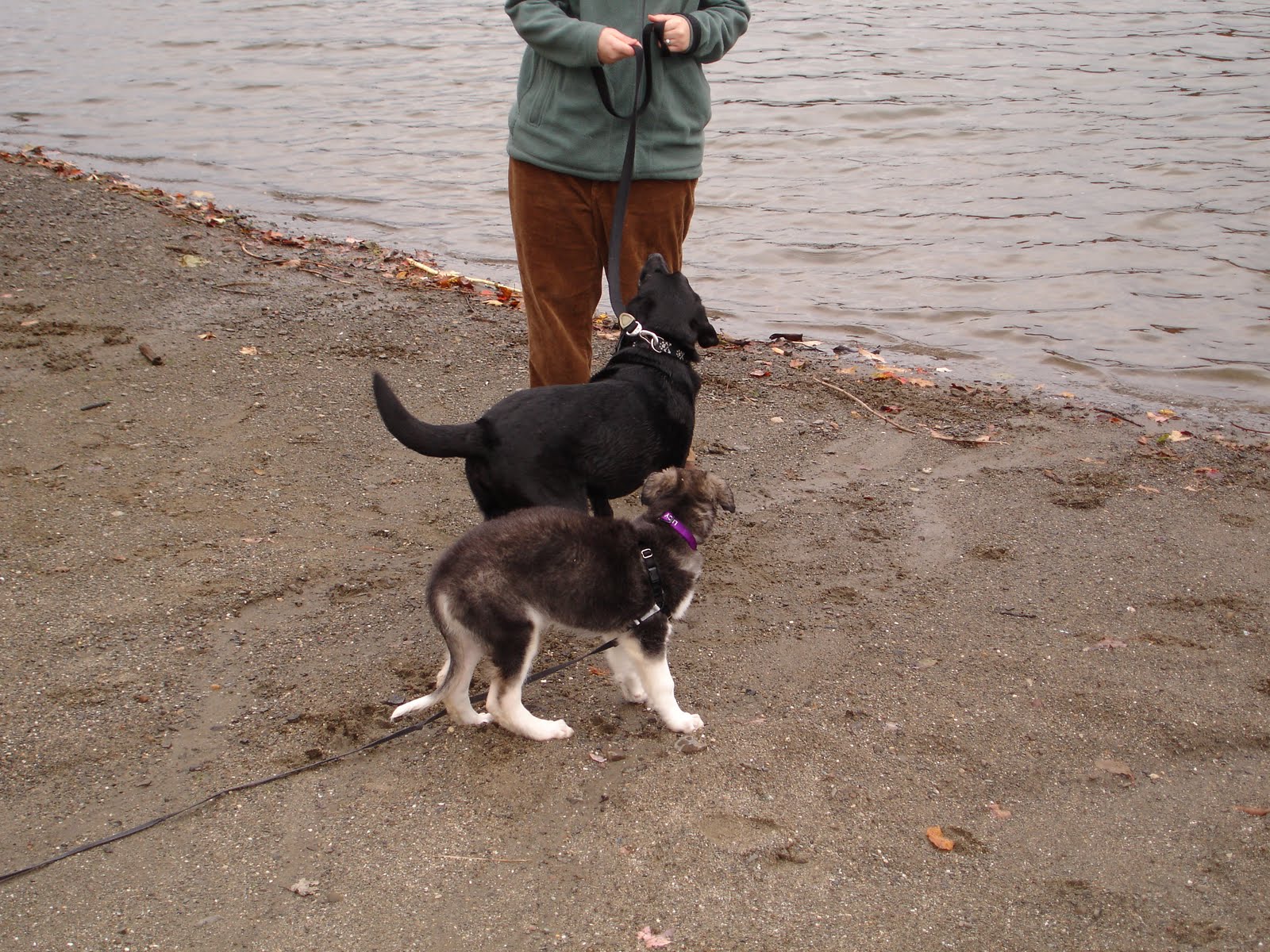
Sara, a black Labrador had wonderful manners with all dogs, she was a good choice for Melissa to socialize with. But we watched carefully that puppy Melissa did not walk on teenager Sara, or that she did not overstay her welcome.

* Senior dogs may tire more easily.
* Seniors may be frail and may not be steady on their feet. Protect them from injury from a boisterous active puppy.
* A lifting of a lip and a show of teeth from the older dog may be necessary to tell the pup that the game has gone too far with those needle sharp puppy teeth. This is all part of canine body language. Of course if bodily harm is going to happen to either senior or pup, you must intervene. If you are not sure what your dog is saying, have a professional dog trainer who uses humane methods help you learn how to read your dog.
* Some adult dogs prefer not to play with very young puppies, but enjoy playing with adult dogs and older pups. Maybe a few weeks of management is necessary before your senior is comfortable with your new pup.
* Make sure to spend quality time with your senior, they may walk slower, and need to sleep more, but they still enjoy our company.


* Give your senior a play that is off limits from an active pup/adolescent, they will appreciate the time alone to rest. Catera certainly enjoys her quiet time.

Thursday, October 7, 2010

First Therapy Visit

Melissa made her debut as a pet therapy dog yesterday. About a month ago she passed the requirements to become a certified therapy dog. The paper work arrived and Melissa was ready to visit.

When I start a new dog doing therapy work, I take it slow. I watch the dog for any signs of stress, any avoidance, or shutting down. Even though we expose our dogs to LOTS in preparation for the certification test, real life situations can be different.

Here is what was new to Melissa:

1) She has walked on linoleum floors in the past....but never such a long stretch of them. She handled them fine.
2) She has been touched, hugged, kissed, by one, two and sometimes 3 people at a time. What I forgot about was the ID tags that many employees wear around their necks. As they bent to hug or kiss Melissa, their tags touched Melissa around her head. The first few times I praised Melissa and acted like it was the best thing since sliced bread. I wanted her to associated the tags with my verbal praise, to let her know it was ok. I have paired treats with verbal praise in the past...Melissa did fine.
3) Melissa had never seen IV tubing, or a patient with an IV in their arm. I made sure she did not touch, lick or get tangled. Again my verbal praise helped, and targeting of her nose to the palm of my hand helped guide her to the other side of the patient.
4) She has seen wheelchairs, but had never seen a stretcher. She looked and gently moved in that direction, towards the hand reaching out from under the blanket.
5) The beep beep of the blood pressure machine was new...she moved her ears forward and tilted her head. I think would have liked to investigate it further, but I cued her to sit and stay while the patient finished having vital signs taken. Melissa then watched the BP machine be wheeled to another room.
6) The smells of antibiotics, wounds, medications and blood products was also new to her. She didn't outwardly seem to notice, but I know a dog takes in everything. Melissa was very well aware of her new surroundings, it was registering in her brain.
7) She visited with staff, patients and visitors, she enjoys being petted.
8) She showed off her 'take a bow', and 'shake' with each paw.

And before she showed any signs of being tired we left the hospital. I did not want to overwhelm her senses too much. Our visit lasted less then one hour. In the future I will visit longer with Melissa. But for the first few times, I will leave the building while she is still perky and upbeat. The dog who slows and is sluggish after being in a new environment may not be tired, he may be stressed. He is shutting down. New and different can be stressful, to us and to our animals. Best to have her become accustomed to all the new sights and sounds a little bit at a time. I want Melissa to enjoy every moment of being a therapy dog. I am hoping that visiting hospitals and nursing homes will be a large part of her future.

Saturday, October 2, 2010

The recall revisited.......


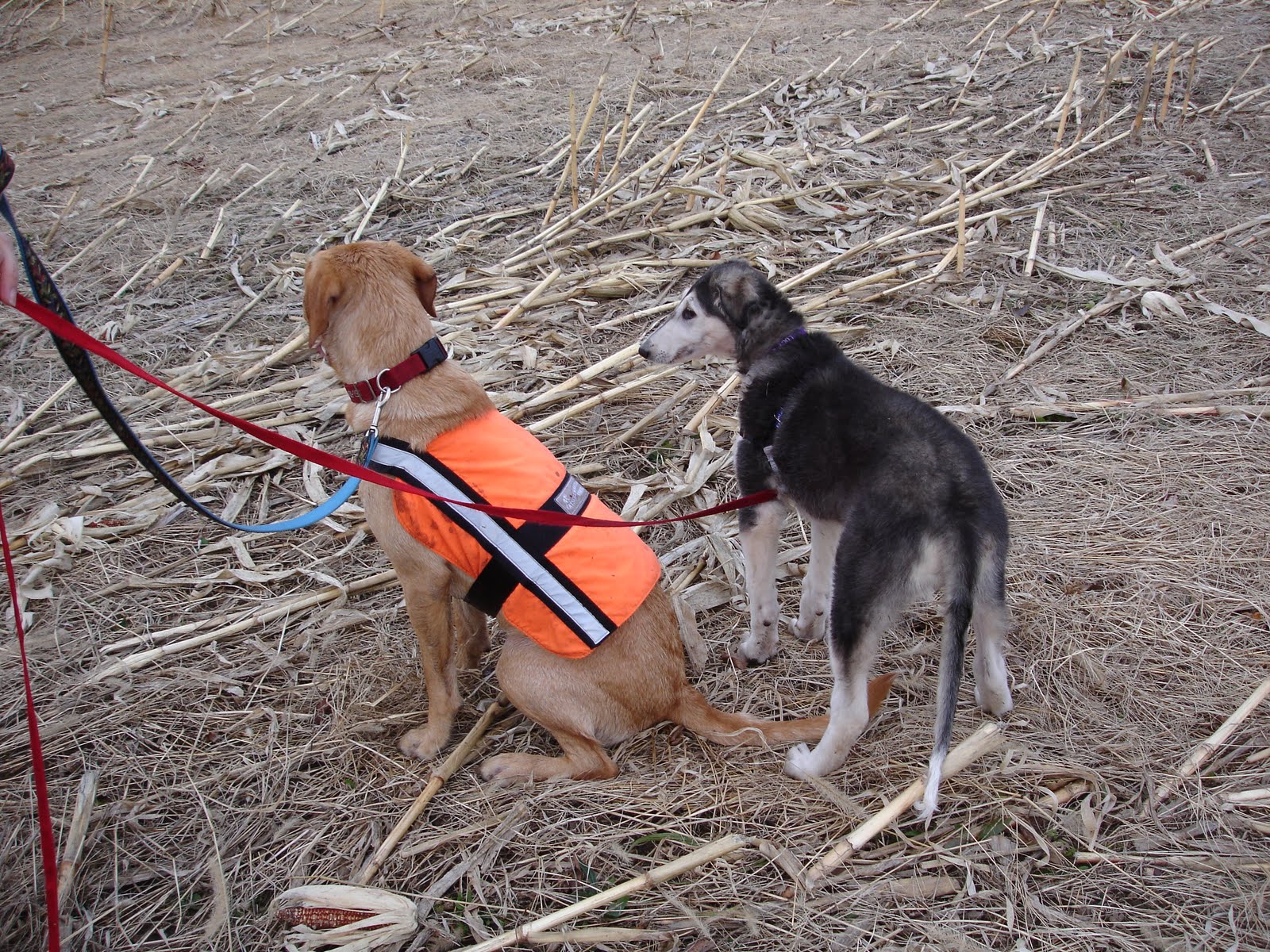
It is a gorgeous October day. My friend Lessa and I took the dogs for a hike early this morning. I had the confidence to let Melissa off her long line for part of the time.

Thanks to Lessa who caught the dogs' pure joy in photos. The dogs ran in the fields and meadows, going one way then the other enjoying the brisk air.


They ran until their tongues hung long.


They sniffed the air, their heads held high.


They sniffed the ground, their muzzles deep in alfalfa.


The pond was a perfect setting, dozens of geese against the fall background.


The dogs took notice of the geese, and in the water they went.....swimming to join the gaggle!!

Luckily both Melissa and Lucy have a fairly good recalls. They heard their names, and turned to look at us...and came swimming back to shore.


Thursday, September 30, 2010

The Really Reliable Recall REALLY does work!!

Early this morning, I let the dogs out to run in a fenced area behind the agility field. Behind this section of the yard is two acres fenced. Melissa took of running. Her intent was clear, she was chasing something. Through the leaves on the far side of the fence I saw a buck. Melissa was in hot pursuit. My heart skipped a beat as I realized I had not checked the fence line after we had some heavy rain and wind. I was stumbling over fallen limbs to get to Melissa. Was the fence down? Would she run into it? Obviously the perimeter fence was down to permit the deer to enter the back two acres.

Without thinking I called out 'Lissa'. She had been trained to come when she hears her name, but not with this level of distraction. I didn't want her crashing into the fence, nor did I want her to get into the back area with the buck if the fence was down where Melissa was running. Upon hearing her name, 13 month old Melissa turned instantly ....and came running back to me!! Melissa got lots of praise and all the treats in my pocket! The many months of practicing Leslie Nelson's Really Reliable Recall with Melissa worked!

I will not slack off training after this one perfectly wonderful response. I will maintain name response by practicing and rewarding generously, I will continue to make deposits into the 'come when called' bank account. There may be another time in Melissa's future that I need to call her away from something very enticing, I want the same response as I had early this morning. Good girl Melissa, you did well!!

Wednesday, September 22, 2010

Tug of War

I really like to play tug with my dogs. It is a wonderful game to burn off energy. It is a way to play with our dogs indoors and out. But, as with all games, it comes with some rules. You may have heard that tug of war can make our dogs be out of control, show some aggressive behaviors and horrors, be dominant! Not so, if played by the rules, and honestly dogs are not trying to take over our world. If we did not have rules to follow when driving our cars we would have chaos on the road. We follow rules, we stop at red lights, go on green, stop at stop signs, drive on the correct side of the road. Our dogs learn to follow rules when the come to live with us, the learn to sit, wait, and be polite when greeting visitors etc. They must also follow the rules for tug of war.

1) Melissa must wait for an invitation from me to engage with the toy. Never is she allowed to just grab the toy from my hand. This is a self control skill. In the beginning I allowed her to stand before releasing her to the toy, but once sit was on cue, she was asked to sit.

2) She is allowed to move forward to get the toy when she hears 'get it'. As I say this, I also begin moving the toy around. The movement makes it more exciting and Melissa leaps out of a sit to get it.


3) Since I have multiple dogs, I release them to play with their name first then 'get it'. One dog at a time gets to play tug with me. Here Lucy patiently waits patiently for her turn to play.

4) Any time teeth are felt on my skin, the game is over. I let go of the toy and walk away. Melissa has a soft mouth, but even the tiniest feel of teeth on my hand, was enough for me to release the toy and move away. Game over. It took Melissa two repetitions to learn that her teeth were not to touch my skin. Lab Lucy took more reps., she tugs harder and for a longer period of time. I used a lower value toy to begin with, and followed the protocol of stopping the game as just described. Once she understood the rule of no teeth on skin, I increased the value of the toy.

5) Ending the game of tug. Dogs must learn a 'give or drop it cue'. Tug takes two to play. If I stop tugging and hold the toy close to my body, it is not as much fun. I taught this to Melissa by ceasing to tug as I held the toy close to my body. At the same time I offered Melissa a tasty piece of food close to her nose as I said give. Melissa would release the toy and eat the food. I quickly engaged her in another game of tug. Soon Melissa was releasing the toy when she heard the cue to give. I am now beginning to use another game of tug as a reward...she gets to play tug again after she releases the toy. This is an example of how food can be faded out of the picture. Melissa does what I asked, to give the toy to me, and as a reward she gets to play again.

6) Sometimes I let Melissa 'win'. I let go of the toy as I say 'it's yours' and off she goes running with the toy in her mouth. Sometimes I 'win' and end the game and put the toy away. This keeps the game fun for both of us, we both get a chance to have possession at the end of the game. Melissa remains eager to play the game of tug whenever I engage her to do so.

Thursday, September 16, 2010

Walking on Lead

Several owners of new pups have asked me how to teach their pups to walk on lead. Two people in particular are having to pick up their dogs, as they simply stop moving.

If a dog does not want to walk I first look around the environment. Is something out there that is causing the puppy to be afraid, to shut down? It could be something very subtle. A neighbor coming out of their house, a trash can that is at roadside that was not there previously. Perhaps the last time the puppy was out for a walk, an automatic garage door opened and closed and scared the pup. Skateboards, planes over head, cars, cyclists, over head air balloons, all can be a source of something your puppy is unsure of. Did a neighbor's dog give your pup a threatening look, again it could be very subtle. If your pup is not accustomed to reading dog language or the other dog is too assertive, your pup has good reason to be unsure. It could be a combination of some of these things.

I let the pup drag a ribbon or very light line, on a flat buckle collar attached to a front clip harness. The harness prevents any tightening around the collar, many dogs get scared, they feel the pressure and they freeze. Others back off, making it tighter. It can be a scary situation during a critical time in their life.


If you have another dog that the pup will follow, pick up the ribbon or line and follow along. If you have no access to another dog, try having the pup follow a person. The person should be someone the pup knows and is comfortable with. Have them play with the pup and then walk away, chances are the pup will want to follow. You will pick up the ribbon or light lead and follow along.

This is your pup's first lesson in lead training. On a separate topic: put on your to do list: find another pup or appropriate adult for your puppy to play with, it is a critical part of his socialization.

Let the pup lead you the first few times. No need to put pressure on his collar/harness. I train before meals...when Melissa is most hungry. Ok, she is always hungry...I am blessed with yet another Borzoi who is a really good eater. But in the beginning she didn't know what to make of the lead. I let her drag it, when she followed a dog or person, she did feel some pressure on her harness if she got too far in front of me and I couldn't keep up. Life is not totally free of aversives......this is one of those cases that life happens. I never pulled on her collar/harness intentionally. In a separate session I taught her to accept hands touching her all over her body, along with mild pressure on her collar.

When she was comfortable dragging the light line, I began to hold it in my hand.....placing items on the ground that she wanted to investigate toy or a treat, she went in a straight line doing just that....and with me holding the light line. That was training session number two.

When Melissa first arrived I fed the first few meals from my hand, she learned that good things come from me. She focused up at me, we practiced walking on lead, a loose lead, while she followed her food bowl. At this point I began to click and treat when she was close to my left side.

If a puppy won't eat while out on the road, chances are something is bothering him, he has shut down. Practice on the side or back yard of your home, in a quiet parking lot or park where there is minimal distractions to worry him. My favorite place for dogs working thru challenges like this, is a mall parking lot before the stores open. Place toys, plates of food around one parking space before you take your pup out of the car. When you have arranged all the items on the ground, take him out and let him investigate while you hold onto the lead. Verbally praise when he is moving forward. Don't cheer lead when he is stationary. Reward for movement. Keep training sessions short....two to three minutes at most.

Attach a light line or ribbon on your pups collar/harness. Put a fuzzy on a string and let him chase it and catch it. Let him play with it, we want him to get excited about it. Then repeat, but this time you hold the fuzzy off the ground a bit. With you holding his lead, and him following the fuzzy, for a feet feet before you allow him to have it, he has yet another training session for walking on lead.

Buckles on leads....get them as small as you can. Melissa had a buckle made for a toy dog the first week of lead training. No need to weight the pup down with a heavy buckle or heavy lead.

Let them have fun on walks. Formal heeling and walking at your side will come in time. Take things in small increments. Melissa is a year old, I have yet to introduce her to the word 'heel'. Instead I am shaping her to being close to my left side, my left hand at my waist is becoming the cue. She looks forward to moving close to my side, it means lots of clicks and treats are coming her way.

Take all training in tiny increments, the final goal will come. As friend and instructor Patty Ruzzo used to say 'enjoy the journey'. And so it should be with all we do with our dogs, from puppy hood to adult hood. Happy training!